ACTION 07

Precision Insertion

Inserting a part into a tight-clearance target to establish a geometric fit between two bodies

Why It Matters

Insertion is the point at which an assembly joint is actually made. Examples include mating connectors and pressing in retainers, plugging in power and data connectors, and inserting packing material into its specified position.

Dedicated press-fit machines and insertion fixtures assume that part position and pose are the same every time. In high-mix assembly and field installation, alignment must be inferred from force and moment alone immediately after entry.

Skills 6

07-AMulti-Point Insertion

The part has several mating points that must all be within tolerance at once, and correcting one pushes another out of alignment.
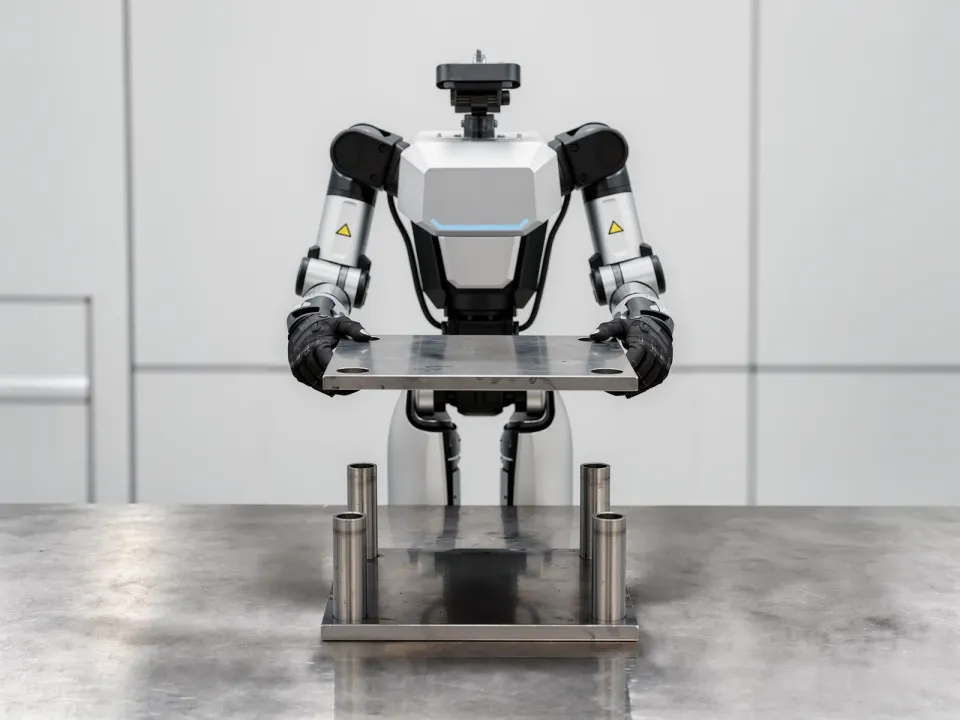

Multi-Point Insertion — Initial state
Initial stateA part with several mating points and its counterpart are separate.
Multi-Point Insertion — Final state
Final stateAll mating points are engaged together, and the parts are joined.
C_geom appliesC_force appliesC_contact appliesC_obs appliesC_deform does not applyC_dyn does not apply
E1 does not applyE2 appliesE3 does not applyE4 appliesE5 does not apply

07-BThreaded Insertion

The first thread engages only when the axes are aligned within a narrow entry angle, and rotation started out of alignment causes irreversible damage.


Threaded Insertion — Initial state
Initial stateA threaded part and a tapped hole are separate.
Threaded Insertion — Final state
Final stateThe first thread is engaged, and the part has entered the hole without thread damage.
C_geom appliesC_force appliesC_contact does not applyC_obs appliesC_deform does not applyC_dyn does not apply
E1 does not applyE2 appliesE3 does not applyE4 appliesE5 does not apply

07-CDeformable Object Insertion

The part buckles under axial load, so misalignment cannot be overcome by pushing harder.

Deformable Object Insertion — Initial state
Initial stateA part that buckles under axial load and its target opening are separate.
Deformable Object Insertion — Final state
Final stateThe part is inserted into the target opening without buckling.
C_geom appliesC_force appliesC_contact appliesC_obs does not applyC_deform appliesC_dyn does not apply
E1 does not applyE2 appliesE3 does not applyE4 appliesE5 does not apply

07-DKeyed Insertion

Only one orientation passes through, so the part's current pose must be identified before entry, and even a slight deviation prevents entry entirely.


Keyed Insertion — Initial state
Initial stateA part that fits in only one orientation is separate from its mating opening.
Keyed Insertion — Final state
Final stateThe part is inserted into the opening in the specified orientation.
C_geom appliesC_force does not applyC_contact does not applyC_obs appliesC_deform does not applyC_dyn does not apply
E1 does not applyE2 appliesE3 does not applyE4 does not applyE5 does not apply

07-ESearch-Based Insertion

Neither the target's location nor the shape of the mating feature can be observed, leaving no reference for alignment.


Search-Based Insertion — Initial state
Initial stateA part is held, and the target opening cannot be observed.
Search-Based Insertion — Final state
Final stateThe part is inserted into the target opening.
C_geom appliesC_force appliesC_contact appliesC_obs appliesC_deform does not applyC_dyn does not apply
E1 does not applyE2 does not applyE3 does not applyE4 appliesE5 does not apply

07-FMicro Insertion

The part and clearance are so small that the alignment tolerance falls below the smallest observable unit, and success itself cannot be observed.


Micro Insertion — Initial state
Initial stateA part and a clearance, both near the limit of what the naked eye can resolve, are separate.
Micro Insertion — Final state
Final stateThe part is inserted into the clearance.
C_geom appliesC_force appliesC_contact does not applyC_obs appliesC_deform does not applyC_dyn does not apply
E1 does not applyE2 appliesE3 does not applyE4 appliesE5 does not apply