Dexterity Regimes
Dexterity is not a property of the hand but the capability to accomplish a task. The question is whether the required state change can be achieved under the constraints the object imposes, not which hardware achieves it.
Where OSC Axes break down what makes an Action difficult, Dexterity Regimes define the capabilities needed to overcome it.
Manipulation unfolds across space, time, and contact. It requires fixing precisely where to grasp before touching, matching timing to rapidly changing states, and using force and touch to read and handle contact states that cannot be seen. Only when all three are achieved in real time can this be called Dexterity. Dexterity should therefore be defined not by how much the hardware can move, but by which states can be observed and which changes can be stabilized. Adding the range of grasp configurations that underpins these three and the ability to divide a task into phases and recover from failure gives five capabilities in total: the Dexterity Regimes.
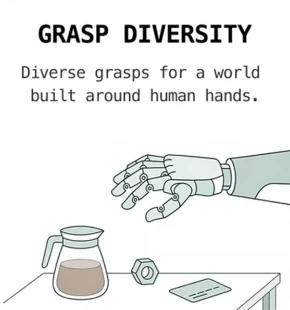
E1Range of achievable grasp configurations
Each object calls for a different grasp, so the range of contact configurations that can be formed must be broad.
Contact must be established before any other capability can work, so this range is a prerequisite for the remaining four Regimes.
Key Question
Can the robot form the grasp configuration the object requires?
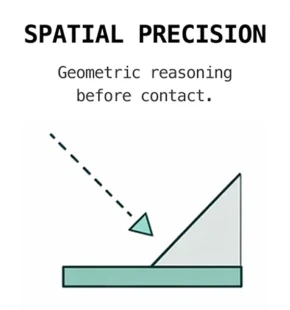
E2Spatial precision before contact
The geometric relationship between the object and the end-effector must be resolved to the required precision before contact.
This precision is settled before contact, which sets it apart from regulating force after contact.
Key Question
Can the robot resolve the contact position within a narrow tolerance?
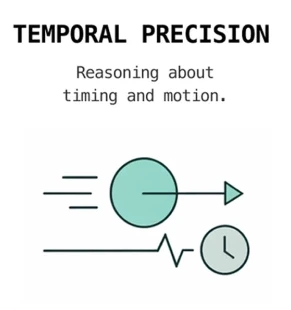
E3Understanding and controlling state change over time
Changes in state over time must be tracked, and motion must be initiated, switched, stopped, and replanned in step with those changes.
Accurate positioning does not succeed if the timing is off. This capability is distinct from spatial precision.
Key Question
Can the robot track a changing state and control motion accordingly?
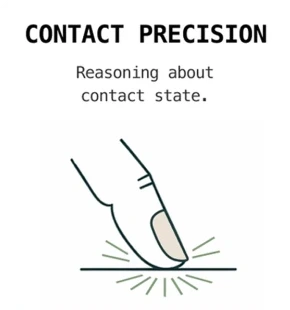
E4State estimation and force control through contact
The object's state must be estimated from force, torque, and tactile signals, and contact force kept within the admissible range based on that estimate.
It operates in a domain vision cannot see, so spatial precision before contact cannot replace it.
Key Question
Can the robot read the object's state through contact and control force accordingly?
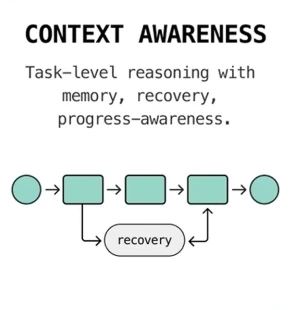
E5Phase decomposition and failure recovery
The task must be decomposed into phases, failures must be diagnosed, and the right recovery path must be chosen.
This capability is required regardless of how accurate individual motions are.
Key Question
Can the robot decompose the task into phases, diagnose failures, and switch to a recovery path?
The five Regimes address different conditions. A single Action may require several Regimes at once, and that combination constitutes the Action's difficulty profile.
Patterns
OSC Axes → Dexterity Regimes
There is no single right way to resolve a bottleneck; the approach changes with the object and the environment. The same geometric complexity can be addressed by precise positioning before contact, by changing the grasp configuration, or by reading the state through contact. Even so, certain Dexterity Regimes tend to be required when certain OSC axes apply. The patterns below show the most common connections. The Regimes shown for each Skill are assessed individually, based on that Skill's own bottleneck.
PATTERN A
C_geomC_contactE1Grasp Diversity
When feasible contact configurations are structurally insufficient, the range of grasps that can be formed determines success.
PATTERN B
C_geomE2Spatial Precision
When the admissible pose envelope is extremely narrow, geometric accuracy before contact determines success.
PATTERN C
C_dynC_obsE3Temporal Precision
When the state changes faster than the sensing, estimation, and actuation loop can respond, timing determines success.
PATTERN D
C_forceC_contactC_obsE4Contact Precision
When the critical state lies in the force and tactile domain rather than in the visual domain, force-based response determines success.
PATTERN E
C_deformC_obsE5Context Awareness
When deformation is history-dependent and occurs under occlusion, the structure of branching and recovery determines success.
Sensing
Sensor and Data Strategy
Each Dexterity Regime has its own sensing requirements and data collection priorities.
| Regime | Primary Sensors | Data Priority | Control Strategy |
|---|---|---|---|
| E1 Grasp Diversity | RGB-D cameras, tactile arrays | Shape diversity, grasp coverage | Grasp planning, contact optimization |
| E2 Spatial Precision | High-resolution stereo, laser profiler | Ground-truth pose accuracy | Visual servoing, compliance control |
| E3 Temporal Precision | High-frame-rate cameras, IMU | Timing traces, latency profiling | Predictive control, reactive policies |
| E4 Contact Precision | F/T sensors, tactile sensors | Force profiles, impedance logs | Impedance/admittance control |
| E5 Context Awareness | Multimodal sensor fusion | Phase annotations, failure taxonomies | Hierarchical task planning |